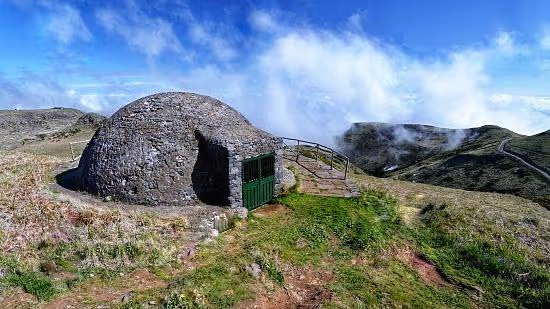
Poço da Neve: Madeira’s Mountain “Freezer”
High up on the winding road to Pico do Arieiro, far above Funchal’s sun‑drenched harbour, sits a curious stone dome that looks as if it has been transplanted from the Arctic. In reality this iglu‑shaped structure is neither an igloo nor a hobbit’s house but the last surviving Poço da Neve (literally “snow pit”) on Madeira. Long before electricity and domestic freezers, ingenious Madeirans found a way to keep ice through the summer. They dug deep pits in the mountains, roofed them with carved basalt blocks and lined them with straw to preserve the winter snow. The result was an 18th‑ and 19th‑century cold chain that connected mountain snow to city sorbet.
A mountain ice store carved from basalt
The Poço da Neve near Pico do Arieiro is an impressive piece of vernacular engineering. According to heritage records, it has a round shape with a diameter of 7.5 metres and a height of 8 metres. From the outside it resembles a giant stone igloo, but beneath its hemispherical dome lies a deep cylindrical well hewn into the volcanic soil. The walls and dome are built from carved basalt stones bound with lime mortar, creating a tough, insulated shell. This reservoir could store around 265 cubic metres of ice; another source gives a slightly lower capacity of 256 cubic metres, but either way it was large enough to keep Funchal’s gentry in chilled drinks throughout the summer.
The snow pit sits at about 1,600 metres elevation and is dug partly into the ground to maintain a naturally cool interior. Layers of snow and hail collected from the surrounding peaks during winter were packed tightly inside, separated by straw to absorb meltwater. The high altitude and thick basalt walls helped prevent the ice from melting. In a time before refrigeration, this simple physical principle allowed ice to be stored for months.
Origin stories: English family or Italian sorbet maker?
Like any good Madeiran tale, the origins of the Poço da Neve have several competing versions. One story, recorded on a local heritage website, claims the snow pit was ordered in 1813 by an Italian who made sorbets. In this telling, a resourceful Italian confectioner realised that if he could secure ice year‑round he could offer the island’s wealthy residents the ultimate luxury: frozen desserts in July. Another version asserts that an English family built the ice pit to ensure cool drinks and perhaps the occasional gin fizz. A modern travel site goes further, stating that the pit was constructed in the early 19th century and that its circular architecture allowed ice to remain frozen, serving hotels, ice‑cream makers and hospitals. A Portuguese tourism portal agrees that the reservoir has a cylindrical form and was used in the past to store ice. Whether the initiative was English or Italian, the concept reflects a cosmopolitan Madeira where merchants and hoteliers were eager to adopt new technologies.
How the mountain ice economy worked
Once the winter snows had been compressed into the pit, teams of men would return in the summer to retrieve the ice. They broke off blocks and loaded them into leather bags or wicker baskets. The descent to Funchal was not for the faint of heart: agile porters carried the heavy, melting cargo down steep trails and bridle paths. Some accounts describe donkeys or mules helping with the load; others portray barefoot men sprinting downhill to beat the sun.
In the era before domestic freezers, ice was a luxury commodity. According to the Ocean Retreat site, the clients for this hard‑won mountain ice included hotels, ice‑cream manufacturers and hospitals. Hospitals used ice to reduce fevers and preserve medicines. Confectioners churned ice with fruit purées to produce sorbets that were the height of sophistication – imagine enjoying a lemon granita at Funchal’s fashionable Ritz café while knowing that the ice had been quarried from a mountain 1,600 metres above. High‑end hotels chilled drinks for their aristocratic guests and offered iced puddings that were otherwise impossible in a subtropical climate. The trade was so lucrative that the carriers themselves were often paid handsomely, although they risked broken backs and frostbite.
The amount of effort invested in a scoop of sorbet will make you appreciate your kitchen freezer. Whereas today we reach for a bag of ice without thinking, in the 19th century ice was deemed a precious and rare resource. Each piece represented hours of labour: harvesting snow, packing it into the pit, insulating it with straw, then hauling it down to sea level before it melted. No wonder the Italian sorbet maker (if he existed) was protective of his supply.
A living monument to ingenuity
Hundreds of snow pits once dotted Madeira’s mountains, but only this example near Pico do Arieiro survives in good condition. Its uniqueness led the Autonomous Region of Madeira to classify it as a heritage site of local cultural value on 30 July 1998. The pit has belonged to the Municipality of Funchal since 1936 and is today integrated into the Funchal Ecological Park, an 8 km² reserve that preserves native flora and offers recreational trails. A guide to the park highlights Poço da Neve as a curiosity located at the highest part of the park and notes that it is open daily with free admission. Visiting hours run roughly from 08:30 to 19:00, but there are no gates or ticket booths – this is heritage in its purest form: open, unguarded and subject to the weather.
The structure itself sits just off Estrada Regional 103 (also known as the ER103) en route to the Pico do Arieiro viewpoint. Signs along the road point to Poço da Neve, and there is a small lay‑by where you can park. Portuguese sources specify that the pit is 1.6 km before the Pico do Arieiro viewpoint and at an altitude of about 1,600 m. As you approach, the dome appears unexpectedly among the trees – a grey stone mound dotted with moss and lichen, its entrance framed by an iron gate. The path around the pit is uneven, so wear sturdy shoes and watch your step. Peer inside through the gate and you will see the yawning cavity where ice once gleamed like treasure.
Views, trails and the modern visitor experience
From the pit you can gaze across the mountains to the south; on clear days, the view over Funchal is worth the detour. The sense of elevation and the crisp mountain air make this a fine picnic spot (just keep your sandwich away from inquisitive chaffinches). A municipal hiking guide lists a marked trail between Poço da Neve and the Casa do Barreiro, offering walkers an opportunity to connect the snow pit with other landmarks in the park. Nearby trailheads lead to the Pico do Arieiro summit and to levadas that traverse the Laurissilva forest, giving you a chance to combine history and nature in one outing.
In winter, access to the road may be closed due to snow or ice – a delightful irony for a site dedicated to storing snow. Local authorities occasionally restrict traffic between the Poço da Neve and the Pico do Arieiro during heavy snowfall. At such times the landscape is transformed into a true winter wonderland, and you can imagine how men once trudged through drifts to fill the pit. In summer, the air is fresh and scented with heather, a stark contrast to Funchal’s heat – a natural air‑conditioning long before Dyson fans were invented.
Not just a hole in the ground: social and cultural meanings
The Poço da Neve is a rare example of Madeirans adapting to their environment and turning a challenge into an opportunity. Located on a remote volcanic ridge with little infrastructure, the pit nonetheless plugged Madeira into the 19th‑century European trend for frozen desserts. In a culture where hospitality is paramount, having ice for feasts and medical emergencies was a mark of prestige. It reveals the interplay between mountain and city, labour and luxury, local knowledge and global tastes.
From a cultural perspective, the snow pit is a “living monument” that evokes the tenacity of previous generations. The fact that it still stands – dry, moss‑covered and full of echoes – underscores its robust construction and the respect with which Madeirans treat their heritage. The pit even has a mythical quality: some locals whisper that it holds the memory of all the chilled poncha ever poured. Children visiting today may ask if polar bears live inside. Adults marvel that people once carried ice down a mountain in a subtropical climate. The pit invites all generations to reflect on the interplay between natural resources and human ingenuity.
An enduring story in the age of freezers
Today, Poço da Neve no longer keeps ice; refrigerators have replaced ice pits, and Funchal’s cafés serve sorbet with industrially produced cubes. Yet the structure endures as a symbol of a time when people were deeply attuned to their environment. Whether you approach it as a hiker seeking a quick photo stop, a history buff tracing Madeira’s industrial heritage, or simply someone who appreciates a good story, the snow pit will reward your curiosity.
As you step back into your air‑conditioned car and head towards Pico do Arieiro’s panoramic terrace, spare a thought for the men who once raced down these slopes with 20 kg of ice on their backs. The next time you order an ice‑cold drink in Funchal, remember that there was a time when each cube represented a feat of engineering and endurance. In the Poço da Neve, Madeira’s mountains have preserved a slice of history – and, with a little imagination, the taste of a long‑melted sorbet.