The Unmistakable Xavelhas of Câmara de Lobos and the Art of Catching Black Scabbardfish
Colourful boats with a double‑bowed legacy
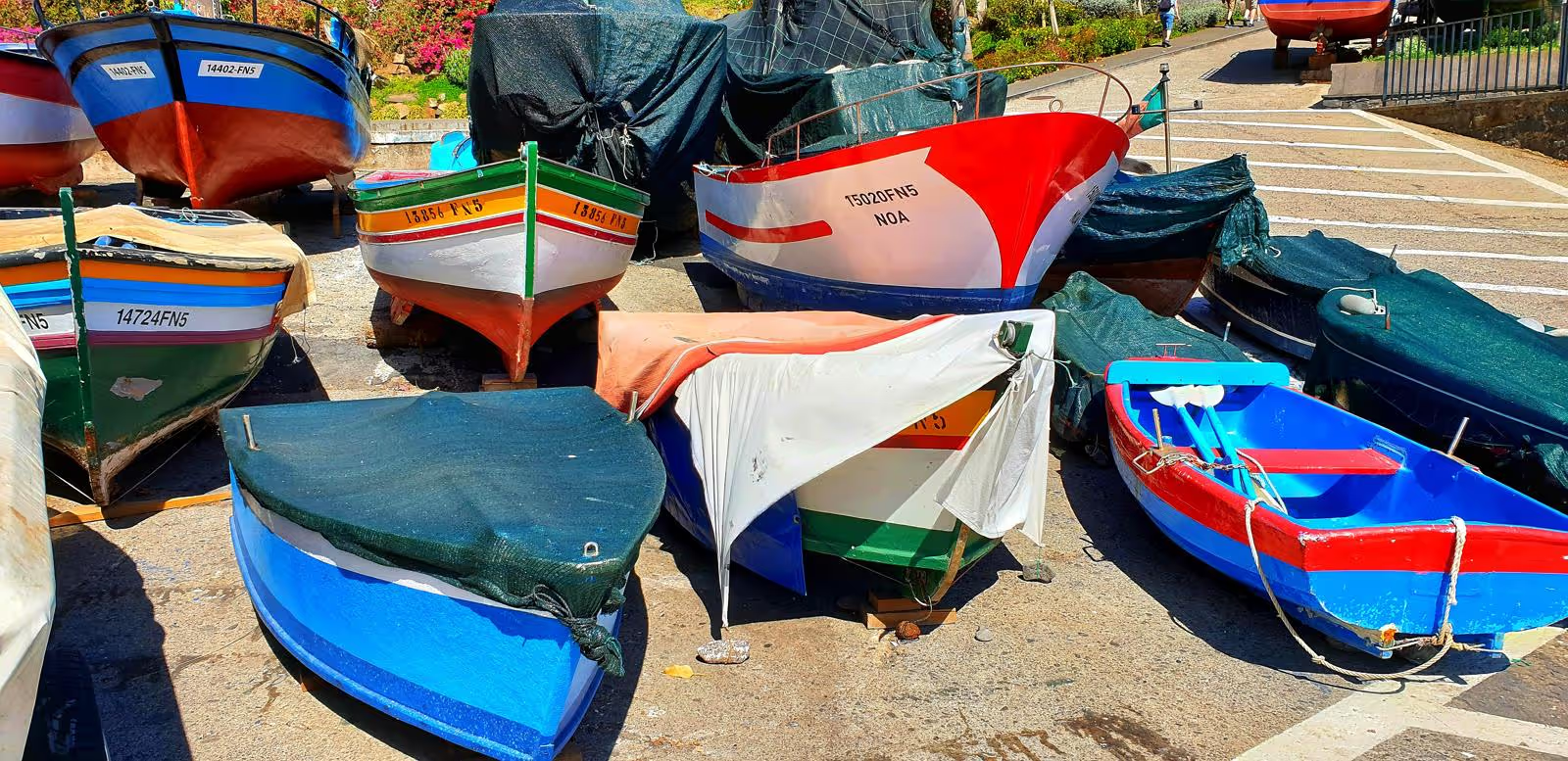
When visitors stroll along the seafront of the fishing town of Câmara de Lobos on Madeira’s south‑western coast, their cameras often linger on the harbour’s wooden boats. These are not generic craft but xavelhas—medium‑sized fishing boats with an unmistakable silhouette. According to the Madeira Ethnographic Museum’s inventory, xavelhas have a distinctive oval hull and are built from horizontal planks; inside, semicircular ribs support four cross‑pieces that serve as benches. Unlike modern motorboats, a xavelha has two bows (hence the nickname barco de duas proas or “boat with two prows”) and no raised fore‑castles. This double‑end design, inherited from older Madeiran fishing craft, allows the boat to be hauled onto steep pebble beaches bow first or stern first, depending on the surf conditions. A central keel runs the full length of the hull and ends in a small propeller, and two side beams lined with iron strip strengthen the structure. The museum record notes that most xavelhas are around seven metres long—large enough to handle the Atlantic swells yet small enough for a crew of two or three fishermen. They are brightly painted with stripes of red, white and yellow along the waterline, black on the gunwale and blue interiors and oars. Each boat displays a unique combination of colours, religious icons and names chosen by the family who owns it.
The xavelha’s origins are tied to the early days of Madeira’s colonisation. Settlers needed a sturdy craft that could navigate exposed rocky coasts and be pulled ashore without wharves or cranes. Over centuries, boatbuilders developed the double‑end design and refined it to suit local conditions. By the twentieth century, xavelhas were an essential asset for families in Câmara de Lobos. During the 1940s a small community even lived on the “ilhéu,” the rocky islet inside the harbour, and worked from their xavelhas. Boats such as the São João de Deus, built in 1936, carried crews to offshore waters to catch tuna, swordfish and the enigmatic black scabbardfish. The boat later retired from commercial fishing, appeared in the 1998 Lisbon Expo and now offers heritage tours for visitors. Locals still take pride in their xavelhas—so much so that the word has also become a nickname for people from Câmara de Lobos. A modern sculpture called “Coroa do Ilhéu,” shaped like a stylised xavelha, honours the fishermen who carved their livelihood out of the Atlantic.
Black scabbardfish: Madeira’s deep‑sea delicacy
The black scabbardfish (Aphanopus carbo) is one of the island’s most coveted seafoods. Ilhapeixe, a Madeira‑based fishery cooperative, notes that this species lives 200–1 700 m below the surface in the eastern Atlantic and can grow up to 145 cm long. It has an elongated, iridescent black body with a sharp lower jaw and long fang‑like teeth. The fish matures at around 85 cm and can live for three decades. Because no scales protect its sleek skin, the flesh remains delicate and white. The scabbardfish is a predator, feeding on crustaceans, cephalopods and smaller fish and migrating up the water column at night.
On Madeira, the species has enormous cultural and economic importance. It accounts for roughly half of the fish sold in the region’s markets, is a cornerstone of Câmara de Lobos’ gastronomy and appears on menus as fillets fried with banana or passion fruit. The steep seabed around the island, which drops quickly into the abyssal depths, makes Madeira one of the few places where black scabbardfish can be caught in sizeable numbers.
Preparing for a night at sea
A scabbardfish expedition begins in the late afternoon. Each xavelha is loaded with longlines—strong main lines several hundred metres long, from which hang scores of secondary lines (known locally as bandeiras) each ending in a baited hook. The Ilhapeixe guide describes the setup: the longline is kept buoyant by floats and kept at the required depth by weights. Fishermen in Câmara de Lobos commonly bait the hooks with pieces of squid or mackerel, whose scent attracts scabbardfish from the dark waters. In the past, each crew member would row out using a pair of heavy oars; today, small outboard motors push the colourful craft to fishing grounds several miles offshore. Modern depth sounders and GPS have made it easier to find the steep underwater ledges where the scabbardfish ascend at night, but the basic technique remains unchanged.
At sunset, the captain aligns the xavelha with the wind and current, then starts lowering the longlines. Weights carry the main line deep—often to 800–1 600 m—while floats ensure that the hooks are suspended horizontally rather than dragging on the seabed. Once the entire line is deployed, with sometimes hundreds of hooks spaced at regular intervals, the crew ties the free end to a buoy and leaves it to soak. Because the scabbardfish are bathypelagic—living near the sea floor by day and migrating upward at night—fishermen wait until darkness to check the lines. Meanwhile, they may set a second or third line in a slightly different area, carefully noting the positions.
The nocturnal haul
Around midnight, lanterns bob on the black sea as the xavelhas return to their first buoys. Fishermen haul the longlines by hand or with small winches, taking care to avoid tangles. The first indicator of success is often the shimmering black body of a scabbardfish breaking the surface. Unlike trawling, which indiscriminately sweeps up everything in its path, longline fishing is selective: each fish is removed from its individual hook and immediately dispatched to minimise stress. As the line comes aboard, the crew removes unbaited hooks and re‑baits them for the next set. If the catch is good—perhaps dozens of fish on a single line—the process repeats with the remaining gear. The fishermen work quickly but methodically, attuned to the rhythm of waves and the weight of the gear.
The black scabbardfish has an eerie beauty when hauled into a boat: its iridescent skin gleams in the lantern light, and its long jaws gape open to reveal needle‑sharp teeth. Some of the fish are set aside for immediate sale at the Funchal fish market; others are gutted, iced and stored on board. The flesh spoils quickly, so the aim is to return to harbour before dawn. The wharves of Câmara de Lobos and Funchal come alive as boats arrive with their gleaming cargo. Buyers—local restaurateurs and market sellers—huddle around, assessing the size and freshness of each scabbardfish. Photos of the night’s catch often show fishermen holding fish nearly as long as themselves, with other species making occasional appearances on the hooks. Although scabbardfish longlines can catch deep‑sea sharks and other species, the percentage of bycatch is low, and regular monitoring helps ensure that the fishery remains sustainable.
Tradition meets sustainability
Scabbardfish fishing is more than just a job; it is a cultural practice passed down through generations. Young fishermen learn how to rig longlines, read the weather and currents, and handle a xavelha from older relatives. In Câmara de Lobos, many families still depend on the fishery for income even though tourism has become a major economic driver. Because the method targets a specific species and is monitored by regional authorities, scientists consider it relatively sustainable. Quotas and seasonal closures help protect the stock, and there is little evidence of overfishing. In fact, the steep underwater slopes around Madeira may act as a natural refuge for the species, and the nightly migration of scabbardfish into shallower water makes them accessible without destructive gear.
There is also a sense of pride that the fishery retains its artisanal character. Unlike industrial deep‑sea fisheries that deploy thousands of hooks over tens of kilometres, the Madeiran scabbardfish fleet consists of small boats—often xavelhas—carrying just a few longlines each. According to Lobosonda’s marine‑life blog, most boats depart daily and the scabbardfish fishery remains central to the economies of coastal communities. The fish are sold locally, exported or served in regional dishes such as espada com banana (fried scabbardfish with banana), espada com maracujá (with passion fruit sauce) or grilled with garlic and lemon.
From workhorse to icon
In recent decades the role of xavelhas has slowly changed. Advances in technology have introduced larger fibreglass vessels and electronic navigation to Madeira’s fleet. Some traditional boats were retired, leaving the harbour to visitors and photographers. Yet locals have not forgotten their heritage. One xavelha, Jamanta, built nearly a century ago, is being restored for display in a museum. Others, like the São João de Deus, still sail, not with longlines but with tourists eager to experience a sunrise on the Atlantic.
Câmara de Lobos has embraced the cultural significance of its fishing boats. Artists have captured their colours in murals and sculptures, while festivals celebrate both the xavelhas and the black scabbardfish. Even Winston Churchill painted the harbour in 1950, immortalising the sight of xavelhas bobbing in the cove. Today, the boats continue to symbolise the town’s identity. They remind residents and visitors alike of a time when life depended on brave crews venturing into the night, relying on longlines and luck to haul from the deep the delicate black scabbardfish.
A final cast
The story of the xavelha and the black scabbardfish is a story of adaptation. Crafted with care and painted like folk art, xavelhas helped generations of Madeirans earn a living from the sea. They were designed for practicality—double‑ended for ease of launching, strengthened with iron strips to withstand surf, painted brightly for visibility—and they became part of the landscape of Câmara de Lobos. The black scabbardfish, lurking in pitch‑black depths, has likewise adapted to the island’s steep underwater cliffs and nightly ascents, becoming a delicacy that defines local cuisine.
When you next enjoy a plate of espada com banana or watch the sunset over Câmara de Lobos, spare a thought for the fishermen who still set their longlines from colourful xavelhas. In a world of industrial fishing and factory ships, Madeira’s scabbardfish fishery remains a small‑scale enterprise where tradition and sustainability coexist. The boats may look like wooden toys in the harbour, but when the night falls and the deep‑sea predators rise, they become part of an ancient, ongoing dance between man and the sea.