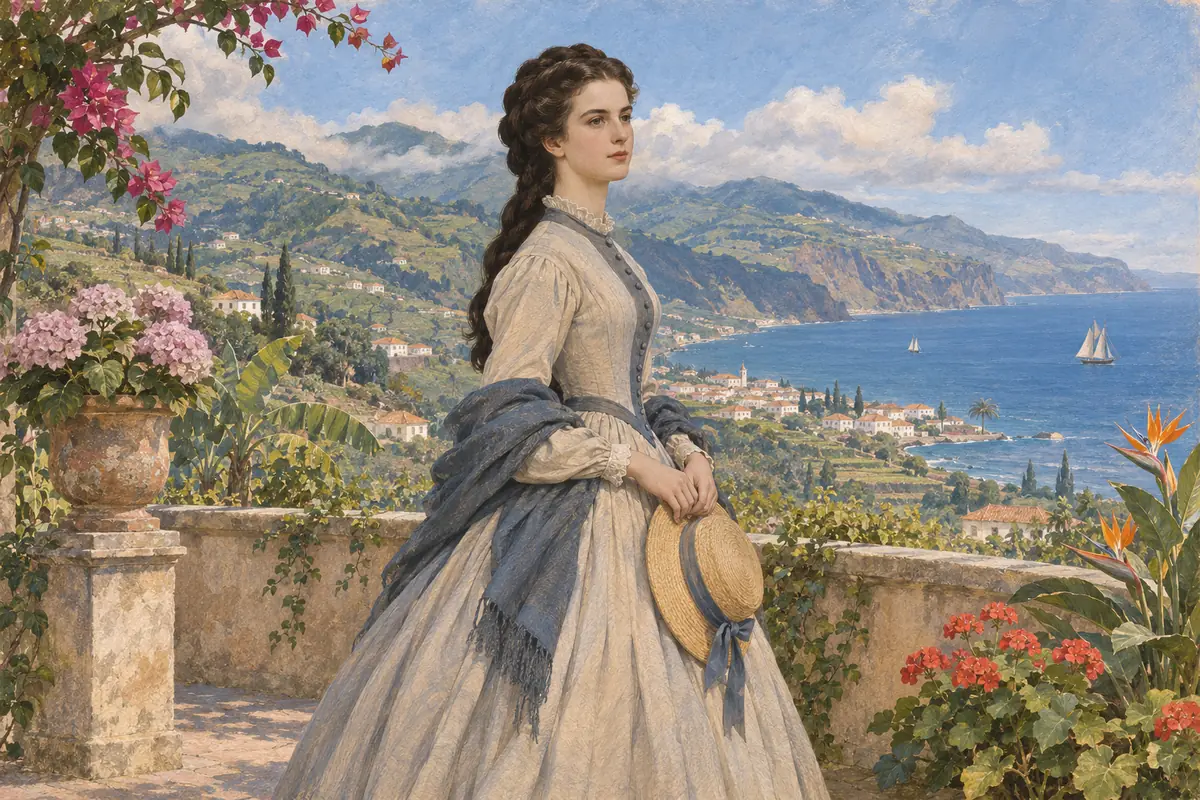
Empress Elisabeth of Austria, better known as Sisi or Sissi, spent the winter of 1860–61 in Madeira for her health. Funchal offered a milder climate and distance from the demands of Vienna’s imperial court. She returned in the winter of 1893–94. Her island story is about recuperation, travel and the growing importance of a life beyond palace walls.
Madeira supplied the ocean views. Vienna supplied rather more rules.
Why did Sissi come to Madeira?
Her doctors recommended a stay in a mild climate after concerns about her lungs. That explains the journey without turning a nineteenth-century medical opinion into a diagnosis we can confidently make today.
Court life also matters. Elisabeth struggled with its rigid expectations and public duties. The Schönbrunn Group’s historical account places Madeira within her growing desire for independence: travel gave her space that court life rarely allowed. Health and freedom belong in the same story; neither needs to cancel out the other.
Her first stay: winter 1860–61
The Madeiran historical encyclopaedia Elucidário Madeirense records her arrival on 29 November 1860 and departure on 28 April 1861. That makes this a stay of about five months, rather more substantial than a royal weekend away.
She travelled aboard Queen Victoria’s yacht, Victoria and Albert. Despite the distance from Vienna, imperial status came with her: Portuguese royal representatives visited during her stay. An ocean crossing could loosen the court’s grip, but it did not make an empress anonymous.
Where did she stay? The Quinta Vigia puzzle
Elisabeth lived at the old Quinta Vigia, also known as Quinta Davies. Be careful with the name: today’s Quinta Vigia, the regional president’s official residence, is the neighbouring former Quinta das Angústias. It took the Vigia name later.
The old estate belonged to the area subsequently redeveloped for the Casino Park complex. The present government residence is a different property. Same name, neighbouring grounds, ample opportunity for a historical mix-up.
Life on the island: beyond the royal postcard
It is tempting to fill five months with a complete imperial holiday itinerary. The evidence deserves more care. Stories about particular outings should not become a day-by-day diary simply because they sound plausible.
One tangible connection is photography. Vicente Gomes da Silva photographed Elisabeth in 1860, a fact recorded by Madeira’s regional cultural authority. It gives her stay a place in the island’s photographic history as well as its royal visitor book. A real person was being recorded here, long before the polished screen legend took over.
Schönbrunn’s account describes her return to Vienna in 1861 as a more self-confident woman. Madeira forms part of that change, though no single island stay explains an entire life. Her later journeys became an increasingly important way of creating personal space.
She came back in 1893–94
More than three decades later, Elisabeth returned. RTP dates the second stay to 1893–94; Madeira’s archive catalogue identifies an arrival on 23 December 1893 and departure on 4 February 1894. The later visit also belongs to the Reid’s story: the regional encyclopaedia Aprender Madeira places her first at Villa Cliff, associated with Reid’s, and then at the hotel itself.
These were two separate chapters, decades apart. A story about the later hotel stay does not tell us how she lived during the first winter.
What can you see in Funchal today?
The Sissi statue in Funchal, near the Pestana Casino Park, commemorates her connection with Madeira. It is a memorial, not a surviving room from her residence. Use the place listing for its location.
Nearby, today’s Quinta Vigia has gardens overlooking Funchal bay. The official tourism board lists the gardens as a visitor attraction; check current access arrangements before going. Remember the distinction: visiting these gardens does not mean entering Sissi’s preserved home.
When you explore this part of Funchal, keep those layers separate: a historical residence, a later namesake and a memorial. The buildings and names have changed. The contrast between imperial obligations and an Atlantic horizon still makes her Madeira chapter worth knowing.
AI-generated historical illustration of Sissi above Funchal bay, inspired by her 1860–61 stay; the scene and likeness are artistic interpretations.